

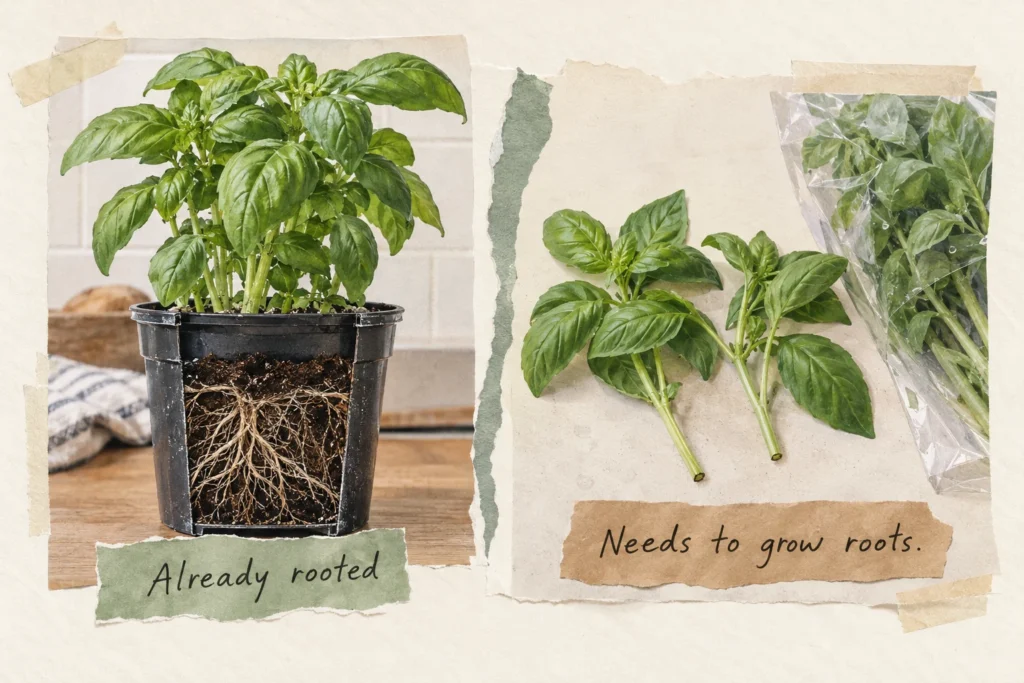
Yes, sometimes. Something with roots is technically a plant already. Something with root systems to grow is considered a cut sprig. Parsley and cilantro stems are experiments, but not worth your time. Loose chives are better off not being saved. It’s better to have a couple shoots saved instead of every green scrap.
First, look at what you actually bought
With parsley, check the package. Usually, a living parsley pot keeps growing. A cut bunch is a not recommended stem-cutting project. Same with chives. A rooted clump has growing tissue. Loose chive blades do not. If a root ball is intact, put in an appropriate container with drainage and watch out for recovery. With a bunch that has only a few roots, I would be cautious. Damaged or missing roots inhibit recovery.
| What’s in the package | What I’d try |
|---|---|
| Basil or mint sprigs | Fresh, leafy stem tips. Basil has explicit extension support for water rooting; mint has established cutting methods. |
| Oregano sprigs | Healthy young shoots suitable for softwood cuttings. |
| Thyme, sage, or rosemary sprigs | Suitable leafy shoots using species-specific cutting methods, not an assumption that any old woody stalk will root. |
| Parsley, cilantro, or dill bunches | Use the bunch for cooking; start plants from seed instead. |
| Loose chive leaves | Use them for cooking. Grow chives from seed or a rooted bulb clump. |
Keep the growing tip, not just the leftovers
Picture me, in an imagined dinner-prep scene, stripping basil leaves for pasta and then eyeing the bare stems beside the cutting board. I’m annoyed: the promised “free plant” now looks like another jar to babysit. Keep two tips, before they are stripped, and saved instead of expecting scraps to do the same job.
Look for a node where a leaf is attached. With clean scissors, cut just below the node and remove the lower leaves. The upper leaves, and the growing tip support the cutting while it develops roots. A detached leaf or a stem stripped for dinner is not equivalent to a prepared shoot.
Look for stems with some length and good, healthy leaves. I don’t see the point in wasting time on moldy or slimy stuff, or stems that look like they’re collapsing. Even stems that look good may have storage issues or damage from being shipped; basil is very sensitive to the cold and can get brown or decayed during transit. While the symptoms may be a result of poor starting material, they may not tell the whole story.
A jar works for basil; it isn’t a universal shortcut
To culture basil in water, remove the lower leaves and stem, and place in a jar with the lower stem and a node submerged in water. Place it in bright indirect light. Replace the water if it gets cloudy or if the cutting starts to decompose. A water culture has its drawbacks; the water needs to be changed, and the air space may become oxygen-poor.
If you’d rather root in a medium, moist perlite offers air spaces as well as moisture and is an option for suitable herb cuttings beyond basil. Insert the prepared lower stem and keep it in bright indirect light. Aim for moist, not waterlogged: the cutting needs water, but developing roots also need oxygen. I like being able to see roots in a jar; the tradeoff is that water-grown roots may suffer more transplant shock when you move them into potting mix.
Roots are progress. Continued growth is the next test.
When water-grown roots are roughly 1-2 inches long, you have a useful cue to try potting, not a finish line. Prepare a small pot with drainage holes and premoistened potting mix, then gently settle the mix around the roots without crushing them. Water and let the excess drain. During the transition, keep the mix from drying out, but don’t leave the pot standing in water.
While your plant is getting acclimated to its new home, you will want to keep your growing light on your rooting shoot and establish basil with strong growing conditions. After a while, you will see new, large leaves, and at that point you can tip harvest the plant. While shoots from yesterday’s jar are ready, don’t rely on them for your weekday dinners just yet.
I would give leftover stems a try, and not turn every bundle into a science project. If you need to, you can buy a more established plant that is already established with growing conditions. This skips the rooting stage.
When your cutting fails to take, this doesn’t mean you are a bad gardener. You can’t always pick the species, conditions, or handling of your plant once you bring it home.
Sources and references
- Penn State Extension: Herb Garden Plants: Basil
- Royal Horticultural Society: Herbs: propagating
- Virginia Cooperative Extension: Propagation by Cuttings, Layering and Division (2009-05)
- Iowa State University Extension and Outreach: Propagating Herbaceous Plants from Stem Cuttings
- Missouri Botanical Garden: Rooting Cuttings in Water
- Frontiers in Plant Science; Rutgers University authors Lara J. Brindisi and James E. Simon: Preharvest and postharvest techniques that optimize the shelf life of fresh basil (Ocimum basilicum L.): a review (2023-09-08)
- Iowa State University Extension and Outreach: Growing Basil in the Home Garden