

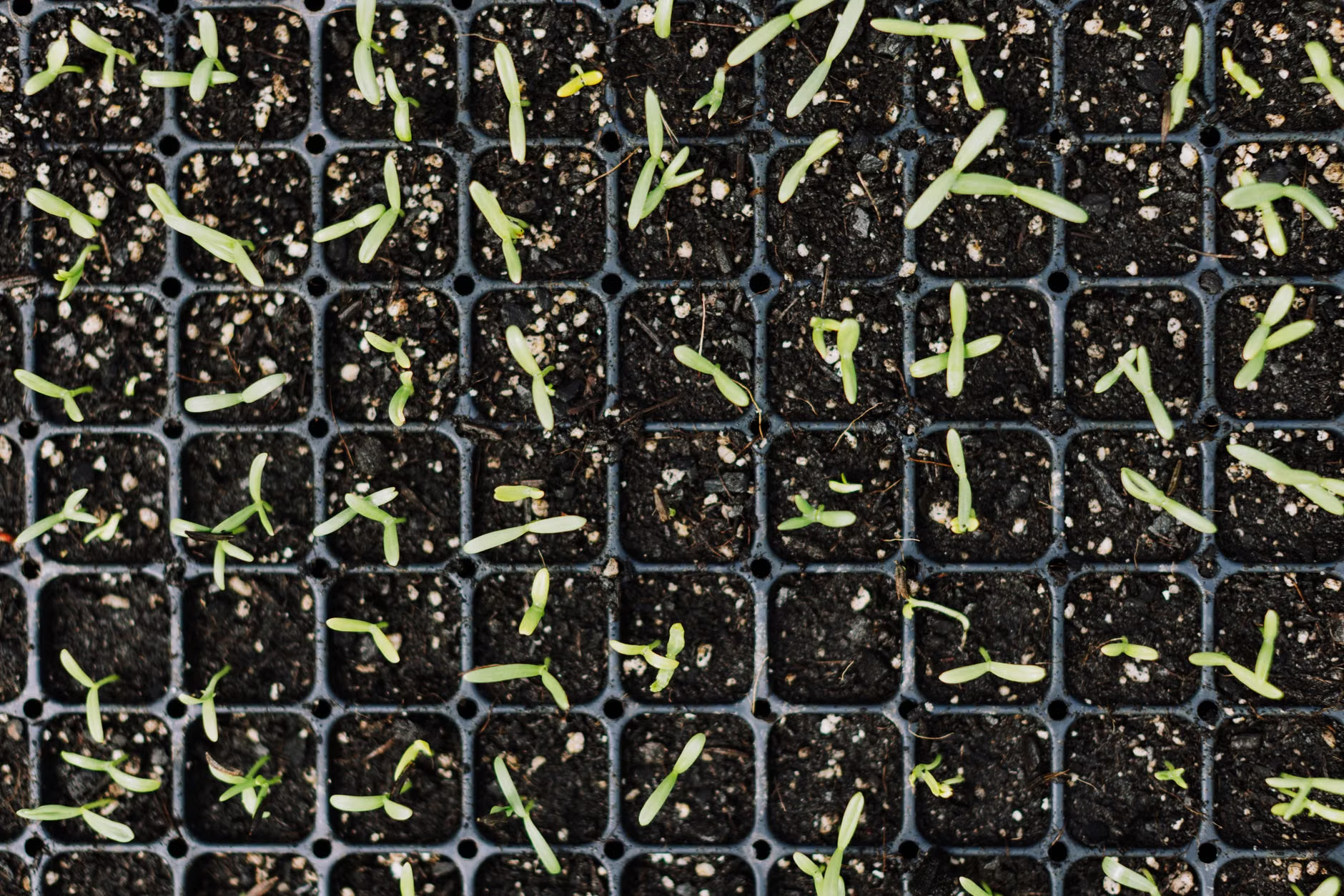
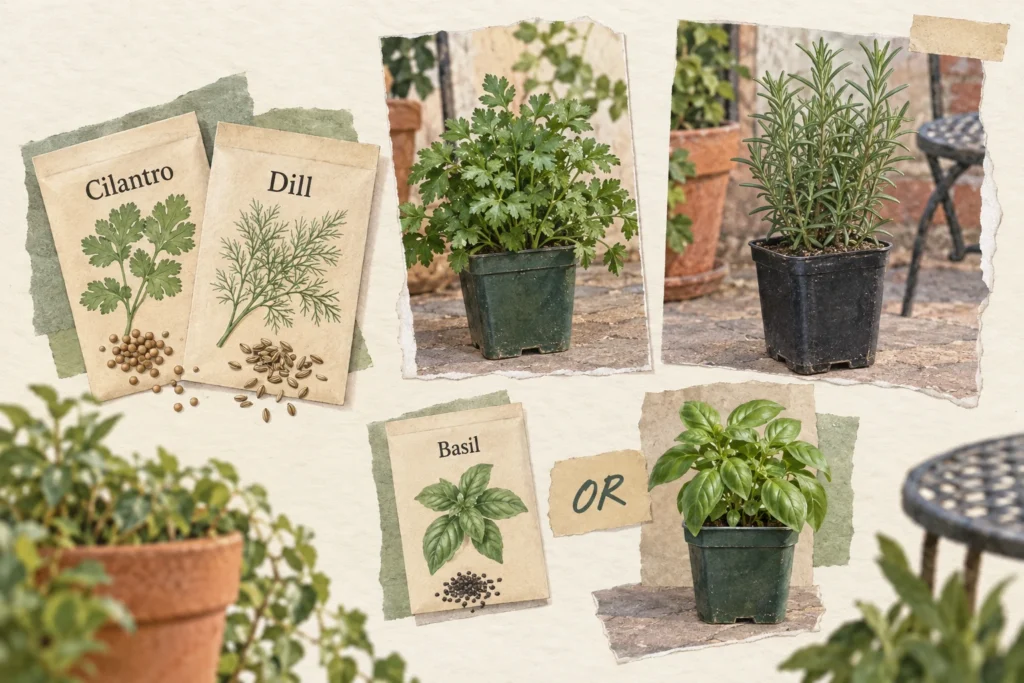
I usually buy mixes for container gardens. Other seeds I would sow directly, like cilantro or dill in their final pots. I would also consider sowing basil if you have warm conditions and time. You can also buy parsley or rosemary for an easy, useful plant. French tarragon also belongs on the plant shopping list.[1][5][6][7]
The price that really matters is your total extra spending divided by the plants you’ll actually keep and harvest this season. A packet of seeds that contains many more seeds than you need is still a good price. However, a seed starting setup is still not a good price.
Imagine me holding a basil seed packet, and then a bag of seed starting mix and a light also appearing in my basket. At home there's room for two basil pots, not a nursery. I would feel less happy about my cheap packet of seeds at that point. I would put everything back and compare direct sowing with a small pack of starts.
Some herbs make the choice easier
Direct sowing and indoor seed starting are different purchases. With direct sowing, you put the seeds into the container where the herb will grow. The Maryland Extension service says that cilantro and dill do not transplant well and suggest direct sowing. Illinois Extension also mentions cilantro and says it has a taproot. This is not a sign that other nursery transplants will not work.[1][4]
Cilantro is good for leaving behind seed for later plantings. Illinois Extension suggests sowing every three to four weeks for a continuing supply, although your available pots limit how much you can stagger. Hot weather causes cilantro to flower, so paying for a large start doesn’t always guarantee a long supply of leafy greens.[4][11]
Of the herbs, basil is the most flexible. You can sow it directly outdoors when the weather is warm, start it indoors, or purchase starts. Parsley is also a good candidate for sowing early indoors or directly sowing when the weather is warm and purchasing starts. Parsley is good for the beginner gardener because it has a taproot that can be easily damaged if transplanted carelessly. However, if you don’t mind the early wait and are looking for a good free plant for your herb garden, offering to divide the plant may yield good results.
Rosemary can also be easily grown from seed, but I would purchase a plant for the garden due to the long wait for a harvestable plant.[1][3][5][6]
French tarragon can’t be grown from seed for the patience versus price dilemma. The flowers are sterile and it is propagated through cuttings, divisions, or offshoots. Russian tarragon is propagated from seed. You will not get French tarragon from a seed packet labeled tarragon. Look for a plant specifically labeled French tarragon.[7]
There is also a third option for getting the herb for free, if you don’t mind being patient. You can find divisions, and therefore a free plant, of chives and mint. You can also divide plants to get offshoots. Building your budget around the hope of a free plant is probably not the best idea, but if you have an offer, you never know what kind of deals you can make.[1]
Count the two plants you need, not every seedling
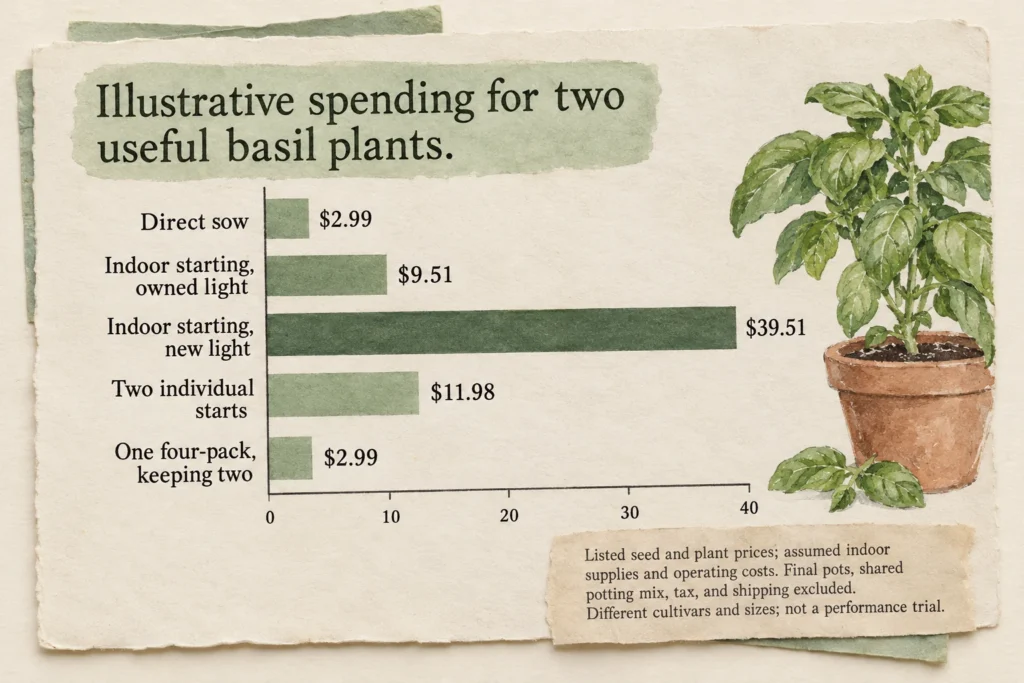
Let’s say you have space for just two basil plants. On October 8, 2026, a price snapshot from Chalet in Wilmette, Illinois shows a sold out $2.99 Genovese basil packet, and Garden’s Dream Farm in Connecticut shows individual 4.25-inch basil pots at $5.99. There is a catch, the packet was sold out and the nursery catalog didn’t confirm if they had it in stock. Listings like these provide a basis for pricing, not a guaranteed shopping opportunity or like-for-like comparison of cultivars.[9][10][12]
| Purchase route | Comparison spending | Cost per useful retained plant |
|---|---|---|
| Direct-sow one seed packet | $2.99 | $1.50 |
| Start indoors with a light already owned | $9.51 | $4.76 |
| Start indoors and buy a $30 light | $39.51 | $19.76 |
| Buy two individual 4.25-inch starts | $11.98 | $5.99 |
| Buy one $2.99 basil four-pack; keep two | $2.99 | $1.50 |
Only the packet and plant prices are observed listings; the indoor supplies and electricity are my illustrative assumptions. I’ve allowed $3 for seed-starting medium, $2 for containers, and $1.52 for electricity, a 20-watt light running 16 hours a day for 28 days at $0.17 per kilowatt-hour. Add those to the $2.99 packet and you spend $9.51, or $39.51 if you also buy an assumed $30 light. That’s first-season cash outlay, not a claim that the light is used up after one season. Running it longer would add to the bill.
If you already had supplies, your first season cost could be lower. The University of Maryland Extension states that cleaned and reused containers with drainage can replace seed starter trays, but a windowsill is usually not strong enough for good indoor seedlings, so a windowsill shouldn’t be budgeted just because it’s free. Final containers and potting soil are not included because they are needed for every route, not because they cost nothing.[2]
Say you buy six seedlings and only two end up in your garden. You’d divide your cost by two because you only got two of the plants you wanted. The cost per useful plant is now double. The same goes for purchased starts. Like I said, giving away extra plants is nice, but it lowers your cost only if you replace that plant with another plant your household actually planned on buying.
I’d check the four-pack option before moving on to large equipment purchases. Garden’s Dream lists Prospera Active Aya basil for $2.99. This listing is for seed, unlike the example, and smaller cells don’t necessarily indicate a better head start than 4.25-inch pots. Regardless, a packet of seeds and a nursery pot aren’t the whole shopping aisle.[10]
What does the head start actually buy?
Waiting for seeds to germinate can make the wait seem short. Botanical Interests lists five to ten days for its Italian Genovese basil to germinate, but recommends four to six weeks of indoor growing before transplanting. Its guidance calls for nights above 50°F for transplanting and soil at least 60°F for direct sowing. I’d use those values to plan my planting, not to gauge when I’d have enough leaves to eat.[3]
There’s also moving outdoors. Indoor seedlings require gradual exposure to sunlight, wind and changing temperatures. Minnesota Extension mentions roughly two weeks for hardening off. Plan for that transition in your calendar rather than using transplant readiness to move seedlings to the patio. Hardening off is adjusting to outdoor conditions, and that’s part of the reason you’re paying for seedlings. If the seedlings are starting their growth outside, they should be hardened off already.[8]
Buying starts outside the growing season won’t protect your seedlings, and many factors impact plant viability. Basil is frost sensitive, and cilantro may quickly flower and go to seed in warm conditions. Check your local frost outlook, and if the window is short, a discounted seedling may not be a good purchase.[3][4][11]
Since I’m making a short list, I’d buy cilantro seed to take advantage of the short window, parsley for a good long term purchase and basil seed or starts for later in the season. Leaving the shelf lights on all the time costs money. Paying to have seedlings grown before you’re ready may be a good purchase.[3][4][6]
Sources and references
- University of Maryland Extension: Care of Herbs and Starting Herbs from Seed (2023-02-20)
- University of Maryland Extension: Starting Vegetable Seeds Indoors (2026-05)
- Botanical Interests: Italian Genovese Basil Seeds
- University of Illinois Extension: Cilantro
- University of Illinois Extension: Rosemary
- University of Illinois Extension: Parsley
- University of Illinois Extension: Tarragon: French
- University of Minnesota Extension: Starting seeds indoors
- Chalet: Botanical Interests Italian Genovese Basil Organic Seeds
- Garden's Dream Farm: Plant Catalog
- University of Illinois Extension: Try Growing Culinary Herbs (2017-02-09)
- Chalet: Contact Us