
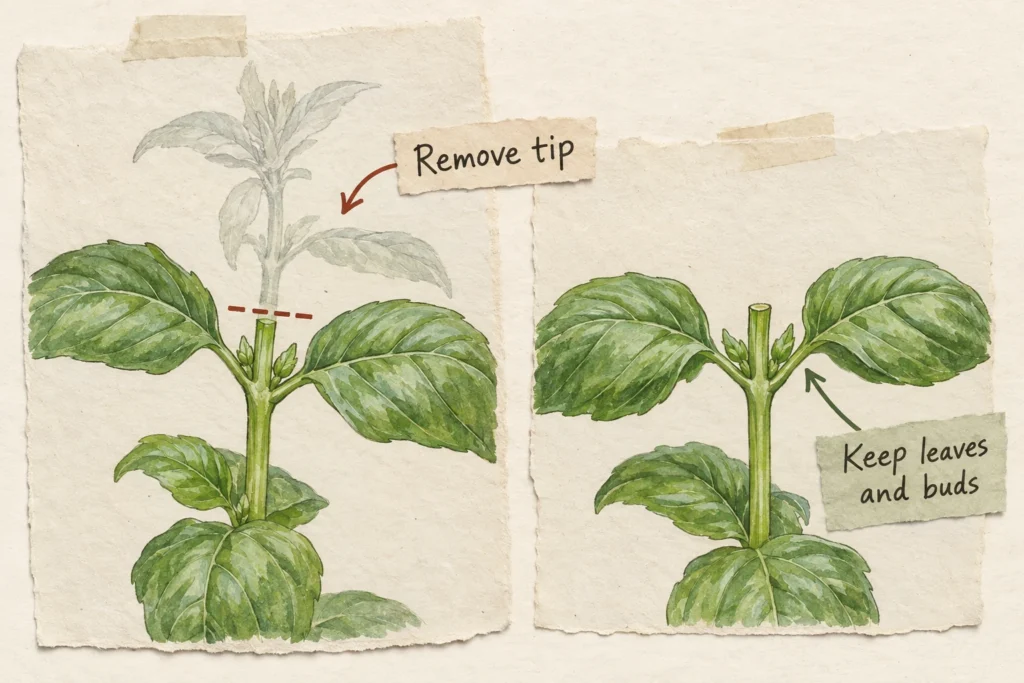
Pinch basil just above a leaf pair to promote bushiness. The leaves below the pinch will provide plenty of surface area to continue photosynthesis. About six to eight true leaves is a good marker for the first round of pinching, not an invite to harvest the whole plant. Flower buds may appear, and if removed, may induce more leaf growth, but this isn't a guarantee. Basil is short-lived and won't remain productive for a long time.
Imagine I’m standing over one basil pot while dinner waits, picking two big leaves because cutting the top feels too drastic. The stalk remains, and I'm anxious about the next harvest. Instead, I find a healthy pair of leaves lower on the stem and take a small pinch, leaving the rest of the stem with plenty of foliage. That's a more useful question than "will scissors ruin it?"
The leaves you leave matter most
For that first pinch, count individual true leaves, not pairs: six to eight leaves usually means three to four pairs. These are the recognizable basil leaves, not the first seed leaves. Then look at their condition. A small plant with healthy, expanding leaves can spare its upper growing tip; reaching a leaf count doesn’t mean it can spare a bowlful.
You may also want to wait to take a major basil harvest until your plant has fully recovered from wilting, losing leaves, or if it's recently been transplanted and has no new growth. Losing its top growing tip will not help a basil plant that isn't getting enough light.
Find the pair, then cut above it
A node is the point where a leaf stalk and the stem join. Side shoots may be present in angles along the stem. The cut should be made at that junction, including the pair of leaves and buds, which may develop into side branches. The main cut does not develop buds into side branches.
There is nothing wrong with removing single leaves for garnish. The error is made when the growing tip is removed. The tip helps to control the size of the plant. I recommend removing the growing tip for a bushy plant and leaves to eat.
To get a larger harvest from a well-established plant, I remove about a third of the leafy foliage, or less if the plant is really vigorous. That's a general household default for herbs, not specific to basil. Use your judgement and take less for a smaller or less established plant. Also count the leaves removed with flowering tips as part of your total, as the plant does not distinguish between being pruned and harvested.
Flower buds aren’t a reset button
Remove flower spikes as they start to develop above a healthy leafy node if you want to promote foliage growth. How early you remove the flower spikes can be debated. Illinois states to remove buds as they start to develop. On the other hand, Utah State says that pinching flowers can encourage more flowering shoots in leaf axils instead of new foliage. Personally, I would remove the flower spikes as early as I can and see what happens.
The first flower isn’t a reason to throw away your remaining leaves. Flowering and seed formation can reduce leaf production and change flavor, so taste a leaf before writing off the plant.
After cutting, watch whether the side shoots expand into useful leaves or quickly form another flower spike. I’d wait for enough leafy growth to replenish the canopy before another substantial harvest, rather than put it on a seven-day schedule. If an older sweet basil plant keeps flowering with few leaves to offer, replacement may be more worthwhile than repeated cutting. You haven’t necessarily harvested it wrong. An annual plant isn’t an unlimited subscription to basil.
Sources and references
- University of Minnesota Extension: Growing basil in home gardens
- University of Illinois Extension: Basil
- Utah State University Extension: How to Grow Basil in Your Garden (2020-05)
- Purdue University: HO-28: Growing Herbs
- University of Minnesota Libraries: 3.2 Shoots, The Science of Plants
- Iowa State University Extension and Outreach: How do I harvest and use herbs grown indoors? (2024-03-19)