

Yes, you can dry herbs in a temperature-controlled dehydrator. I’d prefer it for moisture-rich leaves, humid conditions, or if the harvest is too large to fit in a well-ventilated bundle. Air drying is a sensible no-purchase option for small batches of sturdy herbs in a dry environment. Either way, the herbs, not the timer, decide when they are ready to be jarred.[1][2][3]
Picture me, in an imagined kitchen, trying to hang an armful of mint from one cupboard handle. The bundle fits, but the middle is packed tight and I’m annoyed that my tidy solution has hidden the very leaves I need to dry. I should either divide it or spread the leaves out on a drying rack, not put the entire load on the capacity of a cupboard handle.
Match the method to the leaves and the room
| Your harvest and conditions | The method I’d favor | Why |
|---|---|---|
| A small harvest of rosemary, sage, thyme, or summer savory; dry, ventilated room | Air-drying | These sturdy herbs are straightforward hanging candidates. |
| Basil, mint, lemon balm, or tarragon; especially in humid conditions | Low-temperature dehydrating | Moisture-rich leaves need prompt moisture removal to avoid molding. |
| More herbs than you can hang loosely | Uncrowded dehydrator trays or smaller batches | Squeezing more into a bundle or tray reduces air access. |
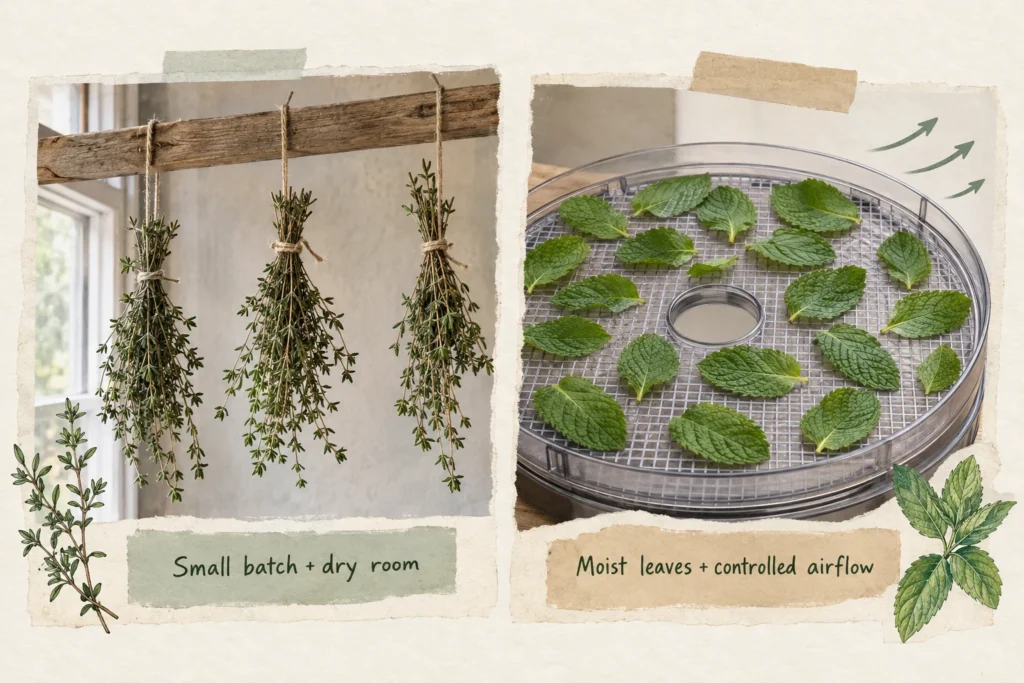
For air-drying, choose a dry, well ventilated area, away from direct sunlight. A warm, dry corner of a room isn’t enough to do the job. Loosely bundle a small amount of stems together (the Minnesota Extension suggests four or five), or fewer if the bundled leaves are tightly packed together. Leave a bag open to catch leaves if desired, but make sure it has air holes so moisture can escape.[1][3][4]
For leaves that are still tender after air drying, I’d go for the dehydrator. The cuts of herbs don’t always tell the whole story, such as how a thicker, more moist stem doesn’t always mean a long drying time. A tight, crowded bundle can still take a while to fully dry.[1][2][5]
Low heat matters more than owning the appliance
Consider the lowest temperature for each machine model. The National Center for Home Food Preservation recommends temperatures of 95-115°F for dehydrating herbs. Higher humidity may require temperatures up to 125°F. Not all models can reach these temperatures: the FD-28CW model by NESCO is set to 160°F. I don’t think it’s worth it to give up cabinet space for an appliance with limited settings.[1][7]
Rinse sound herbs, pat dry and place one layer on a mesh screen, leaving some space between the leaves to ensure air can flow through. NESCO suggests using a second mesh screen when herbs lift off the first screen. Using a solid surface to cover the mesh defeats the purpose because it blocks the airflow.[1][3][6]
I’d use drying times to plan when to check, not when to close the jar. Maryland Extension gives roughly 1-4 hours for dehydrating, Minnesota gives 2-6 hours, and the NESCO FD-8TSS manual gives 1-8 hours. Those ranges reflect differences in equipment, humidity, leaf thickness, and loading rather than a deadline your batch has missed. Minnesota’s 7-14 days for hanging herbs is an estimate too.[3][4][5]
Check the batch before you close the jar
Leaves should crumble readily, and retained stems should break rather than bend. Try several samples from different trays or the middle of a bundle, including thicker leaves: the crisp leaf on the outside is the easiest one to dry, not proof that the whole harvest is ready. If you find pliable leaves, keep drying.[3][6]
Let the herbs cool, and then store them in a cool, dry, dark place. I’d recommend using clear jars to watch for condensation, and to see how well they dried. Drops of condensation mean they’re not fully dried. If you catch them before they spoil, you can redehydrate them. If you see mold, throw them away. Mold will actually spread through the batch if you just take off the moldy part.[6][8]
As for the redrying, that also doesn’t apply to moldy herbs, or herbs that are known to be contaminated. To test if herbs are fully dried, you can do a crumble test. However, certain studies have shown that Salmonella can survive on dried herbs like Chamomile and Peppermint for a long time. It’s better to err on the side of caution. While I hate to see herbs go to waste, if you’ve tended to them yourself and they’ve come to full growth, drying them isn’t going to salvage them.[8][9]
Sources and references
- National Center for Home Food Preservation, University of Georgia: Herbs
- National Center for Home Food Preservation, University of Georgia: The Heat Is On (2015-01-05)
- University of Maryland Extension: Harvesting and Preserving Herbs
- University of Minnesota Extension: Growing herbs in home gardens
- NESCO: FD-8TSS 8-Tray Digital Dehydrator Care/Use Guide
- NESCO: Dehydrator Recipes and Instructions
- NESCO: Dehydrators product category
- National Center for Home Food Preservation, University of Georgia: Packaging and Storing Dried Foods
- Journal of Food Protection / International Association for Food Protection: Survival of Salmonella on Chamomile, Peppermint, and Green Tea during Storage and Subsequent Survival or Growth following Tea Brewing (2015-04-01)