

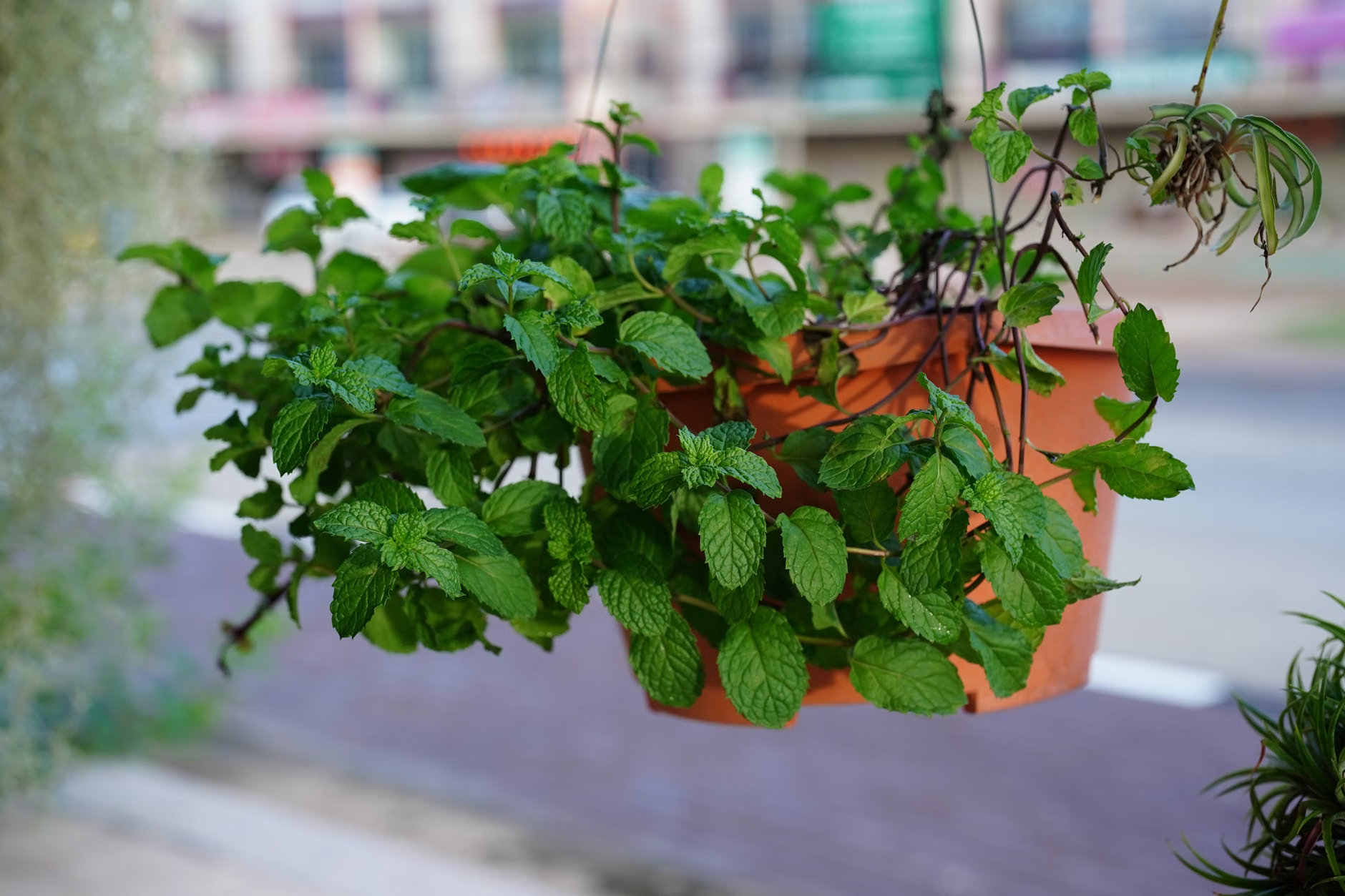
It’s normal for mint to spread. Its stems can produce new shoots across the pot, and roots slowly fill the available space in the pot. You can manage mint growth, but it’s more of a maintenance issue. I’d divide mint when the pot is getting crowded rather than automatically repot it.
Follow the stem, not just the leaves
When it comes to mint, there is ordinary branching where an upward shoot grows from the main stem. Then there are creepers where the stem is touching the growing medium and roots where the nodes touch the growing medium. Mint also has an underground, modifying stem that produces roots and new shoots, and those shoots can appear some distance from the main clump.
For spearmint and peppermint, regular harvesting encourages bushy growth. Cutting the top of the shoots doesn’t do anything to the roots. If you need to manage the mint, I’d separate it rather than keep harvesting it.
A pot can contain the plant, and still offer an exit
The pot has two possible exits: over the rim and through the bottom. Runners can cross the edge and root in nearby soil, while growth through drainage openings can let mint escape a container sitting on soil. I’d put a separate, draining pot on an impervious surface such as concrete, where you can inspect underneath it. You’ll still need to cut back stems reaching toward a bed or neighboring planter.
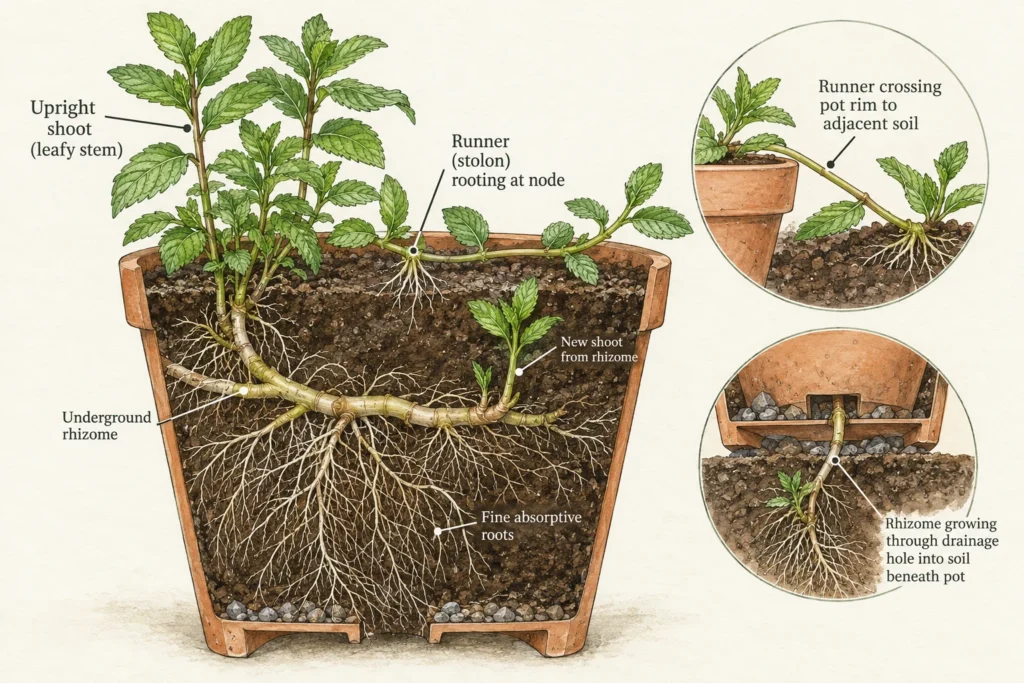
A sunken pot hides part of that job. Maryland Extension recommends leaving about one inch of rim exposed, but that’s a way to restrict spread, not an escape-proof height. You still have to check for stems crossing the rim and growth through the drainage holes. I prefer an aboveground pot because those checks are easier. There’s no universally reliable buried-barrier depth established by these sources.
Plugging the drainage holes to block an escape route is no good; water has to have a way out. Gravel or broken pottery at the bottom of the pot to improve drainage is a myth and doesn’t solve the problem; change the pot’s location, not the drainage’s ability to improve.
Lots of shoots don’t prove the pot is root-bound
If mint repeatedly wilts or water runs straight through, slide out the root ball. What I’d look for is a tight mat of roots around the outside of the root ball, which is also a sign of crowding. This can explain why the center of the root ball isn’t getting saturated. The number of shoots above the soil is not an indicator of crowding.
Runoff doesn’t necessarily mean crowding. Dry mix can shrink away from the pot walls and allow water to bypass the roots, and the mix can be too saturated and cause the plant to wilt. Look for both before dividing the plant. Drooping leaves doesn’t always mean the plant is thirsty.
Keep the pot size you actually have room for
Imagine I’m on a small patio, holding a crowded mint pot and eyeing the only clear corner of the table. A bigger container would push the lunch plates onto our laps. That’s where I’d lose patience with “just repot it” and choose a smaller division for the existing pot instead. I want mint for lunch, not a patio arranged around mint.
For a crowded plant, lift it out and remove some of the shoots and attached roots. Replace the old soil with fresh potting mix, then replant the section at its original depth. Add water. Spring and fall are the recommended division seasons. Choose the conditions nearest your location rather than dividing your plants every year. Use a bigger container if you need more mint and have space.
If mint has already spread through a shared planter, removing it to a separate pot may be easier than continual neighbor rescue missions. Watch for shoots growing from pieces you’ve left behind. If you’re already removing the plant to harvest it, you don’t owe mint your last piece of space.
Sources and references
- Royal Horticultural Society: How to grow Mint
- University of Maryland Extension: Growing Mint in a Home Garden (2026-02-25)
- Ask Extension / Colorado State University Extension: Planting peppermint and/or spearmint #927567 (2026-04-05)
- University of Maryland Extension: Pot-Bound Indoor Plants (2023-03-13)
- University of Maryland Extension: Growing Vegetables in Containers and Salad Tables (2026-09-10)
- University of Georgia Extension, Fulton County: Growing Herbs in Containers 101 (2025-05-09)